Brand database
The whole brand behind one address
For CORUS, we didn't deliver the brand manual as a PDF - we built it as software. brand.corus.ag is an internal web app where the whole brand does its daily work, from the logo files and Office templates to ordering the workwear. Here's what that changes day to day - and why a standalone product is now growing out of it.
Why brand manuals end up in a drawer
Commission a brand and you get a manual at the end: carefully designed, handed over as a PDF, filed away on a drive. From that day on it ages. Two months later someone pulls the logo out of the website as a screenshot because the proper file is nowhere to be found. The print shop asks for vector data and receives a Word document. And the new employee picks the oldest letter template in the folder because it sat at the top.
None of this is bad intent. Between "we have a brand" and "anyone on the team can find the right file in seconds" there's a gap - and that gap is where the distorted logos and the wrong colours come from. No document can close it, however good it is. A document only describes what correct would look like.
For a construction company, the gap costs twice over, because the brand rarely lives on a screen. It hangs on the site fence, rides along on the van, sits on the quote and on the work jacket. Almost every one of those applications runs through an outside supplier, and each supplier needs different files in different formats. This is exactly where the brand database comes in.
The brand as software: brand.corus.ag
So for CORUS we built brand.corus.ag - an access-controlled web app, and after corus.ag and the support site the third web property from the same engagement. It is not a shop window. It is the shelf everyone works from: whoever needs the logo has the right file in seconds - light or dark, for the web or for the vehicle wrap. And the print shop gets a link instead of a folder of attachments.
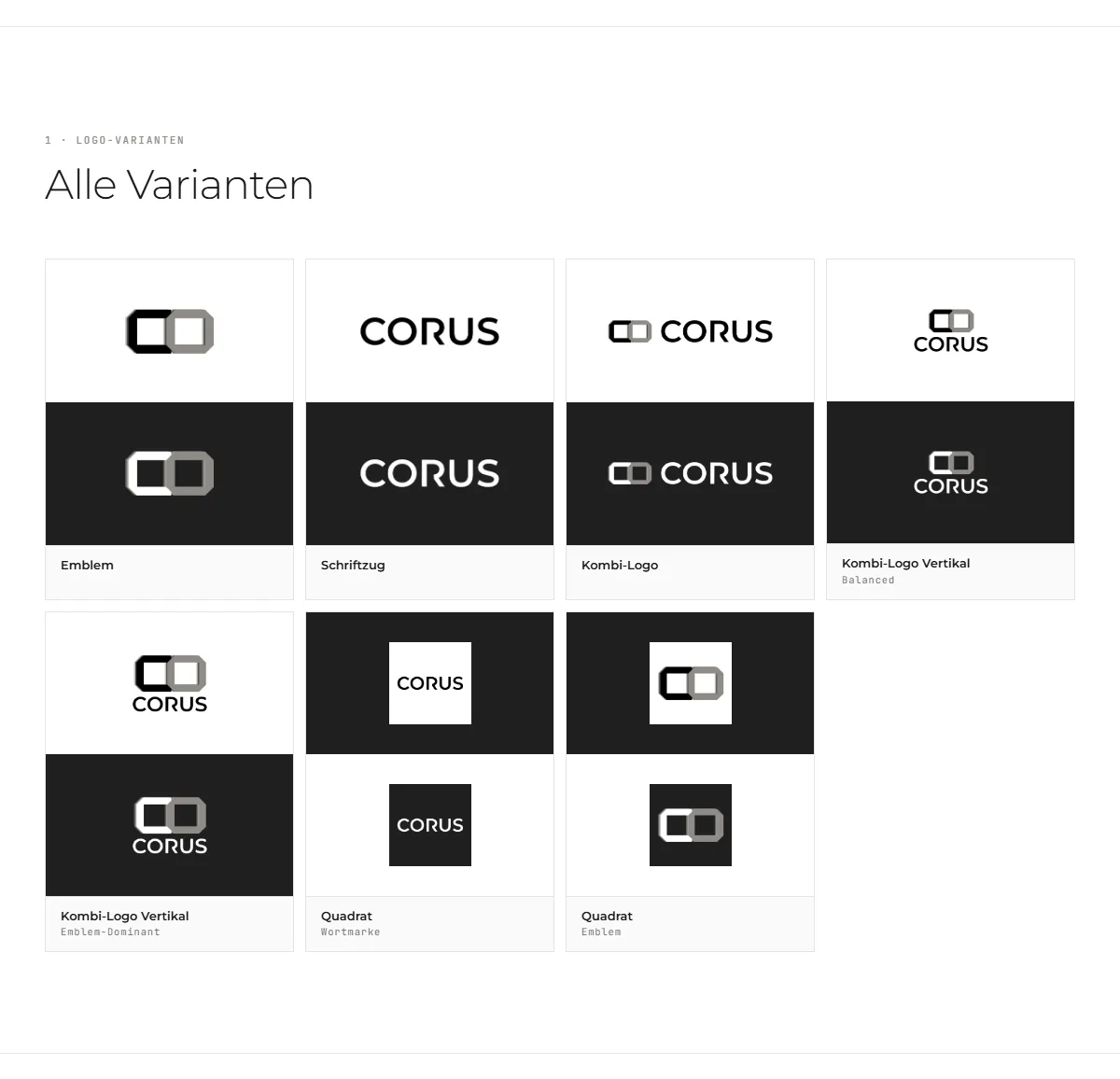
The substance of the brand lives there in full. Every logo variant is ready to download, the web versions with an embed snippet included. Every colour carries all the values anyone will ever need - on screen, in print, on the wrap - with a copy button next to each, so nobody retypes columns of numbers. And the typography comes with sizing systems per surface, from a Word document to a site sign, plus a font package to install.
Light
#FFFFFF
Accent on dark
#C7C3BB · RAL 7044
Accent light
#8E8B85 · RAL 7037
Accent
#2A2A2A · RAL 7021
Accent muted
#1A1A1A
Dark
#1F1F20 · RAL 9005
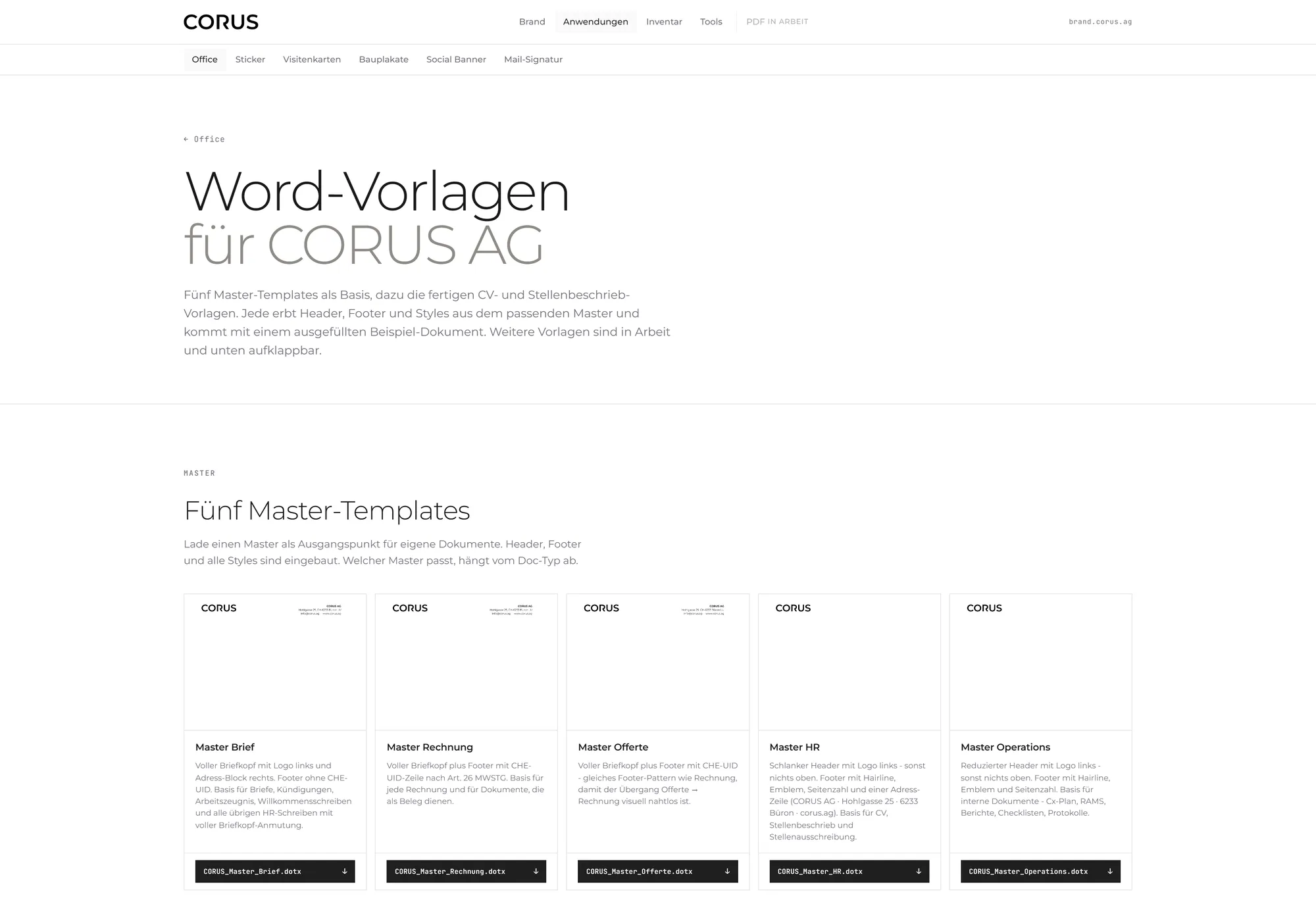
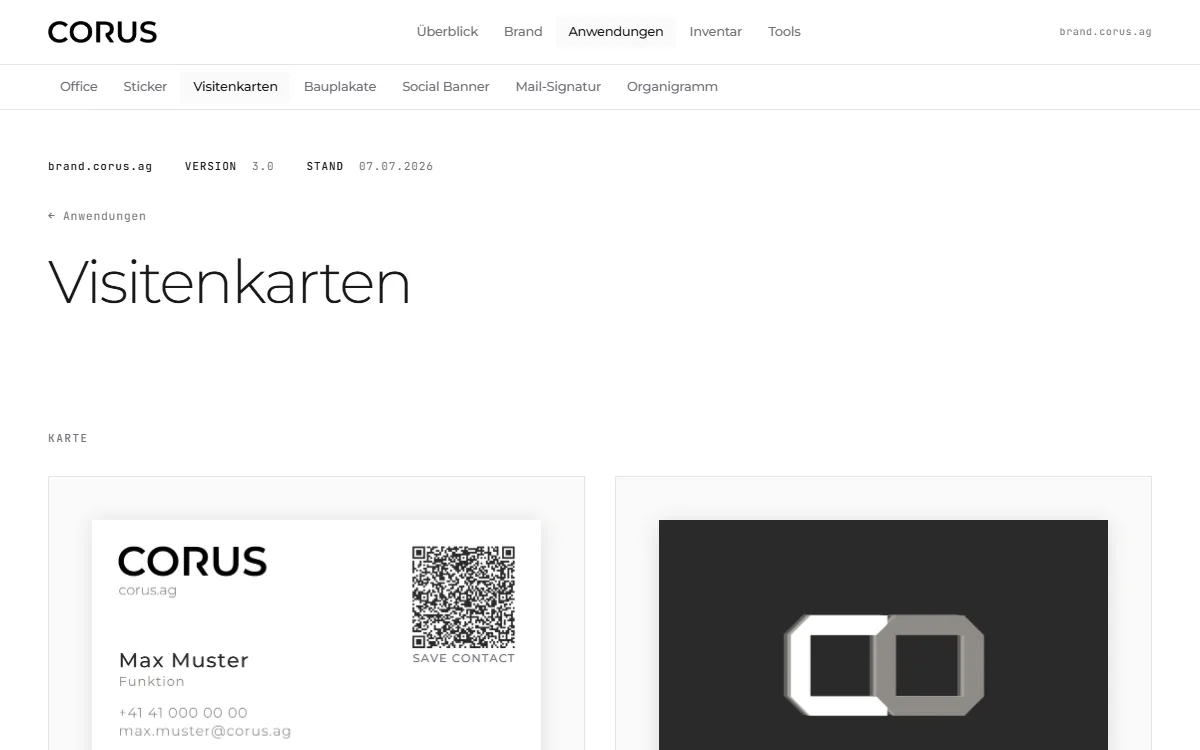
Alongside that, the everyday: the Office templates with preview and download, the business cards, the email signature with a live preview, plus stickers and self-service site signs with a pictogram library for safety and site signage. And the database stays honest about itself: finished templates sit up front, anything still in progress is collapsed and labelled as such - nothing pretends to be done when it isn't.
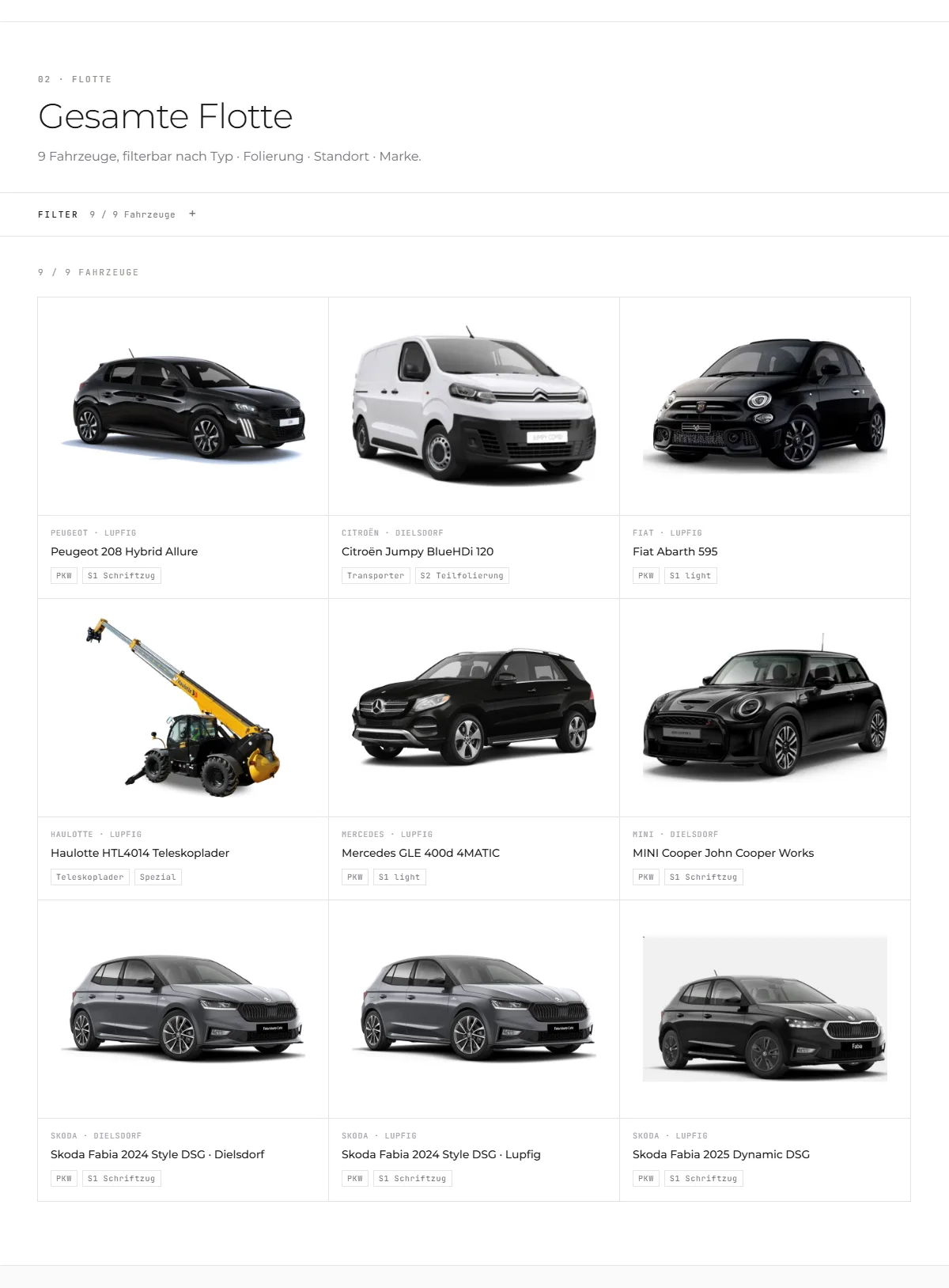
The inventory goes further than a brand manual ever would. The wrapped vehicles and the workwear are recorded as stock, each role has its kit defined, and a dedicated section keeps track of orders. A step-by-step guide explains the ordering, written for people without an IT background.
And for the outside world there are dedicated views: the wrapping and workwear suppliers each see a page with exactly the files and colour values their trade needs - behind one address that always shows the current state. Anyone who still wants a document gets one: the classic style guide can be generated as a PDF straight from the database.
Why this is software, not a document
From the outside, brand.corus.ag looks like a website. Technically it is an application - and that difference is the whole point.
Every logo is a record with properties, every template too, down to the single piece of workwear. The pages are generated from that data: change the state once and every view that shows it changes with it, out to the supplier pages. There is no second version of the truth for someone to keep in sync by hand.
On top of that sit tools that produce things themselves. The sticker generator takes a project code and returns a print-ready PDF built on the original template. With the org chart tool, CORUS builds organisation charts directly in the brand look, exports them as an image and saves the state as a file for the next change. Both used to be the kind of job you'd brief an agency for - now they're a form.
And the platform knows access and roles: sign-in through the team's existing Microsoft accounts is built in, and suppliers only ever see their slice.
This is what we mean by custom software. Not every application belongs in an app store. The most valuable software is often an internal tool that maps one specific working day - and turns a rulebook nobody reads into a system that pulls its weight.
A product is growing out of this
Underneath, what we built for CORUS isn't tied to CORUS at all. Every company that runs a brand has the same gap between manual and daily work, and it closes the same way everywhere: with a database instead of a document.
That's why we're developing a standalone product version a company can set up for its own brand. It isn't finished, and we won't promise anything here that isn't already running at CORUS. But if you'd like to run your brand this way, we're happy to talk now.
Deep DiveThe brand database was one piece of the CORUS engagement - the full story, from the website to the migration night, is in the flagship case